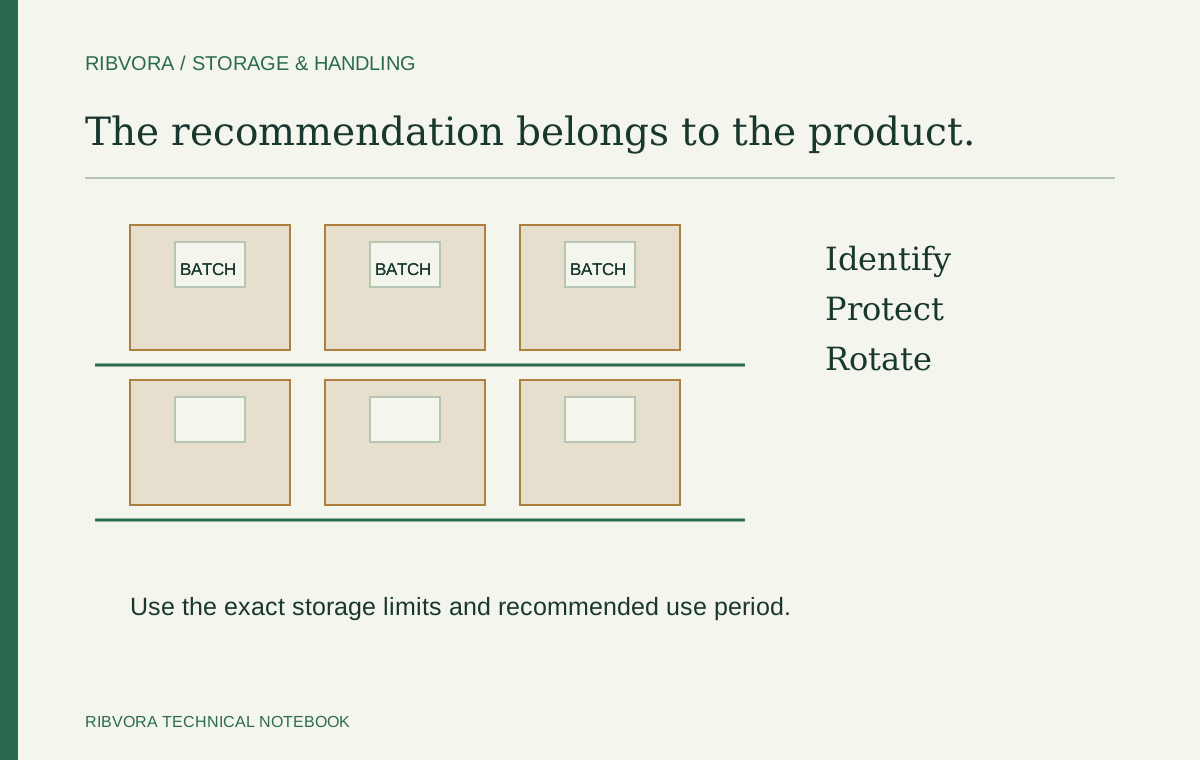
Follow the exact ribbon manufacturer’s storage limits and recommended use period. Keep rolls protected from unsuitable heat, light, moisture and physical damage, retain batch identification, and inspect stock before releasing it for production.
Start with the product-specific instructions
Do not copy a storage limit from an unrelated ribbon and apply it to your whole inventory. Obtain the current guidance for each approved formulation and keep it accessible to the warehouse and purchasing teams.
For example, ARMOR-IIMAK’s AXR 7+ page recommends storage away from light at 5–35°C and 20–80% humidity, with use within 12 months after production when its stated conditions are respected. Those are that product’s published recommendations, not RIBVORA specifications or a universal limit for all ribbons.
Receiving checks before shelving
Check that the roll or carton identification agrees with the purchase order. Record the batch and production identification provided by the supplier. Inspect for crushed packaging, damaged cores, loose winding or visible contamination.
Where transport conditions are a concern, document the issue and ask the supplier how to assess the affected batch. A visual inspection alone does not prove that a roll exposed to unsuitable conditions will perform normally.
- Approved formulation and roll configuration
- Quantity and packaging condition
- Batch and production identification where supplied
- Visible damage or signs of contamination
- Applicable storage guidance and recommended use period
Make stock rotation traceable
A useful stock record connects the roll reference, batch, receipt date and recommended use period. Rotate inventory using the supplier’s applicable guidance rather than assuming all stock has the same shelf life.
For distributor inventory, preserve enough identification to connect a customer quality question back to the supplied batch. If rolls are repacked under a private label, agree how the original traceability is retained.
Handle the roll as a printing material
Keep the film and roll protected from dirt and mechanical damage. Follow the printer manufacturer’s loading procedure and avoid handling the coated film unnecessarily. Confirm the orientation before threading the ribbon.
If the roll or core is visibly damaged, separate it for review instead of forcing it into the printer. Mechanical fit and loading problems should be investigated before changing print settings.
Review the first print after a storage concern
Use the intended label material and the approved print setup. Compare the result with a retained accepted sample where available. Record the observed defect and the relevant storage or transport history.
If smudging, wrinkles or breaks occur, do not assume storage is the only cause. Material compatibility, loading and printer setup may also need review. Change one variable at a time and use the supplier’s technical support process where needed.
Include storage in the replenishment plan
A low unit price can be less useful if the quantity exceeds the stock your business can hold and use under the required conditions. Compare the order size with real consumption and available storage.
Ask for the relevant production identification and storage information when reviewing a bulk order. This creates a better replenishment decision without treating shelf life as an afterthought.
Ask when the recommended period starts
A quoted twelve-month period may have a production-based starting date. Ask for the exact formulation’s guidance and the stock identification that connects to it. Do not restart the clock at your purchase-order date.
Include transit and existing inventory in the plan
Compare remaining recommended use time with realistic consumption after delivery. A large purchase may arrive while older stock remains on the shelf. Use actual demand rather than the quantity discount alone.
Keep receiving observations with the batch
Record damaged packaging, crushed cores, loose winding or unclear identification. Photograph the condition before putting the rolls into normal stock. Seek product-specific guidance when storage history or identity is uncertain.
Separate appearance checks from permission to extend use
A roll that looks intact or prints once has not demonstrated an extension of the manufacturer’s recommended period. Ask the responsible supplier for guidance rather than inventing a new expiry date.
Make stock rotation understandable to the next person
Keep the product reference and applicable date information legible. Use the appropriate recommended use-by basis where available. If dates are missing or ambiguous, resolve them before relying on a rotation rule.
Prepare a focused storage enquiry
Send the formulation reference, batch identification, relevant date information and the conditions in question. Explain whether the issue is transit, warehouse storage or stock past its documented period. Different questions may need different evidence.
Further reading & sources
These sources support general technical guidance. Product approval requires evidence for the exact formulation and application.