Give candidate suppliers the same printer, label stock, roll specification, test criteria, order quantity and delivery basis. Compare the approved results, written quotation, batch identification and change-control process before deciding who should receive a bulk order.
1. Give every supplier the same brief
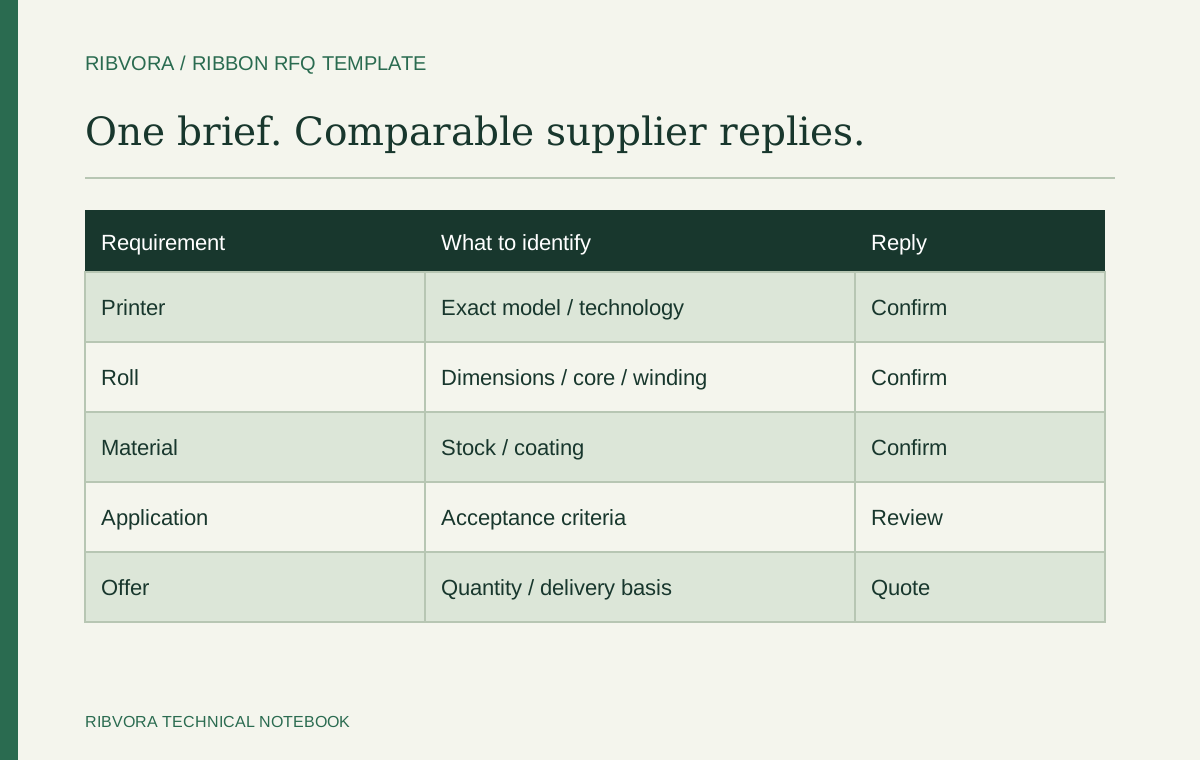
A quotation for resin ribbon is not enough to compare competing offers. Suppliers may interpret the formulation, usable length, packaging or delivery scope differently. Define the application and configuration before requesting prices.
For a converter or distributor, select one current customer application as the first evaluation project. Include the exact face stock and printer details. Ask candidates to identify which information is still missing instead of assuming that a generic category name establishes a match.
- Printer model, resolution and printhead technology
- Label stock manufacturer, reference and surface finish
- Roll dimensions, core and ink-side orientation
- Required print and exposure acceptance criteria
- Quantity per configuration, packaging and delivery destination
2. Make the trial repeatable
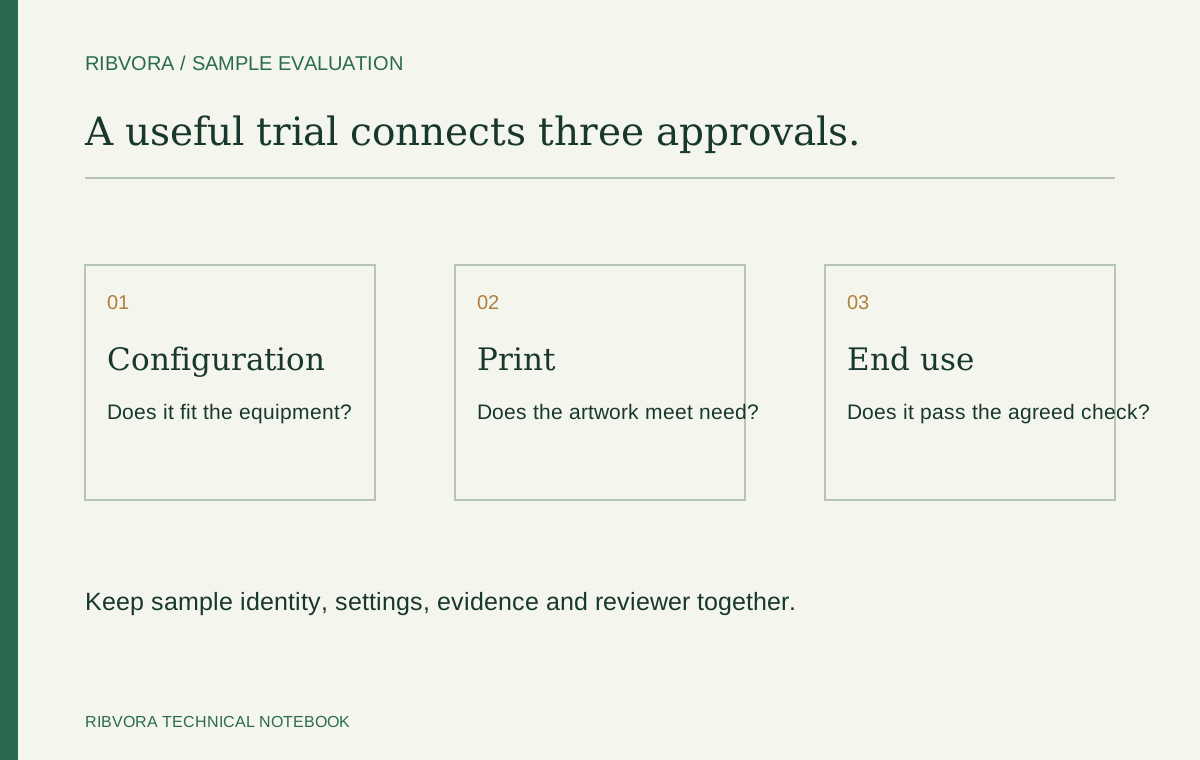
Test candidate ribbons on the actual production stock and equipment. Record the settings for each formulation rather than assuming every candidate needs exactly the same energy setting. Compare the results against the same end-use requirements.
Use production artwork or a test design containing the smallest text and most demanding codes. If a formal barcode grade is part of the requirement, agree an appropriate verification method. A handheld scan can be a useful operational check, but it does not replace a formal grading requirement.
3. Ask how the sample connects to production
A successful sample should have a reference that connects it to the product you are being quoted. Ask how the supplier identifies the formulation, configuration and production batch on a normal order.
Request a written process for notifying you of relevant changes. A trial approval loses value if later orders can silently switch the coating, core configuration or other approved details. This is a purchasing recommendation, not a claim that every supplier already offers such controls.
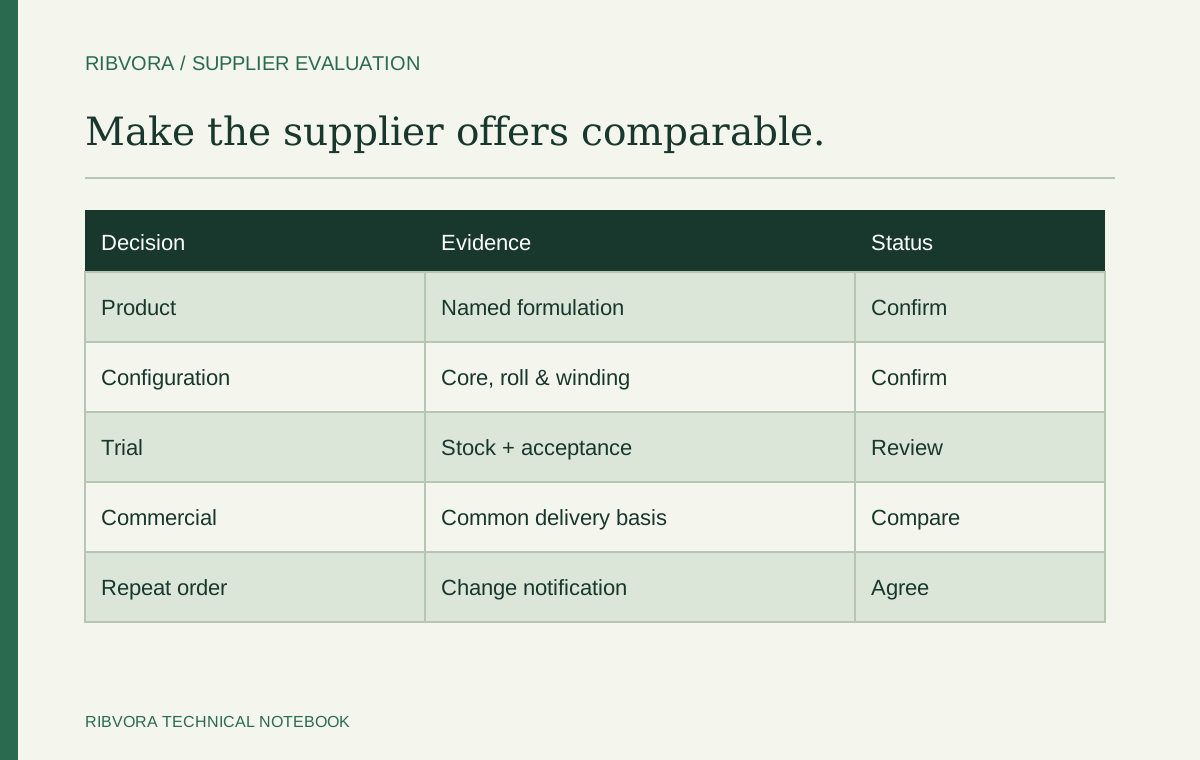
4. Compare quotations on one commercial basis
Check that the prices cover the same roll specification, quantity and packaging. Clarify the delivery term, destination, currency, payment conditions and any separate costs for samples or private-label artwork.
Calculate the contribution using costs that your business actually bears. Freight, import charges, inspection, payment fees and customer delivery can affect the commercial result. Do not infer the likely margin from a foreign retail listing and a factory price for a different configuration.
| Comparison field | Question to resolve |
|---|---|
| Product reference | Is this the formulation evaluated in the trial? |
| Roll configuration | Do dimensions, core and winding match? |
| Order scope | Are quantity and packaging identical? |
| Delivery basis | Who pays and bears each relevant delivery cost? |
| Commercial terms | What are the payment conditions and quoted validity? |
| Quality handling | How are claims documented and reviewed? |
5. Review documents within their scope
Ask for the datasheet and any documents necessary for your application. Check the exact product reference and whether the requirement applies to the ribbon alone or to a specified printed-label construction.
A certificate logo on a website or a document for a different formulation should not be treated as approval of your intended label combination. If a regulated use requires specialist review, resolve that before promising compliance to an end customer.
6. Start with a controlled first order
A limited first order can test the purchasing and delivery process as well as the printed result. Agree the accepted specification and inspect incoming identification against it. Retain a sample and record any defects or configuration discrepancies.
For repeat purchasing, use the same approved reference and track actual consumption. This makes it easier to review replenishment timing and identify changes without starting the technical discussion from zero each time.
Use the checklist as a decision record
Record the result of each check and separate confirmed evidence from open questions. A supplier that clearly identifies what is not yet verified can be easier to evaluate than one offering universal compatibility without conditions.
When sending a RIBVORA enquiry, include one current configuration and the outcome you want to evaluate. Sample availability and commercial terms are reviewed separately; the checklist itself is not an assurance of any supplier’s performance.
Ask for evidence you can connect to the offered item
Check the product reference and document revision. An unrelated datasheet may explain a general technology but cannot establish the scope of the quotation. Keep source material with the decision record.
Review a quality issue before it happens
Agree what information a defect report should contain, how affected stock is identified and who reviews the evidence. A written process is easier to use than an undefined promise of after-sales support.
Keep a second-source trial separate from a price negotiation
Identify the outcome required from an additional source: continuity, a specific configuration or a defined performance result. That purpose should determine the trial and first-order scope.
Compare the first order with the approved sample
Match identification and configuration on receipt. Follow the agreed inspection and application checks. A successful small sample does not remove the need to connect normal production supply to its reference.
Document a decision with open questions visible
Record why an offer was accepted, rejected or held for review. List unresolved conditions and their owner. The result should help another buyer understand the decision without relying on an unrecorded impression of the supplier.
Further reading & sources
These sources support general technical guidance. Product approval requires evidence for the exact formulation and application.