Divide the ribbon cost consumed in a defined job by the number of accepted labels from that job, then multiply by 1,000. Compare only configurations that fit the printer and meet the same print and end-use requirements. Keep ribbon-only cost separate from label stock, labour and other costs.
Start with the labels you can accept
A purchasing team receives two resin ribbon quotes. One has a lower price per roll; the other contains more metres. Neither figure answers the production question: what will the ribbon cost to deliver the required number of usable labels?
Define an accepted label before doing the calculation. It must meet the requirements agreed for the job: the necessary text, barcode performance and any relevant handling or exposure test. A print that looks dark at the printer is not automatically an approved industrial label.
Zebra identifies reprints and material failures as costs that application-appropriate ribbon selection can help avoid. ARMOR-IIMAK also describes its ribbon range in terms of cost and performance. The costing method below is our purchasing framework; it is not a manufacturer test method or evidence of RIBVORA performance.
Use one formula and a consistent measurement boundary
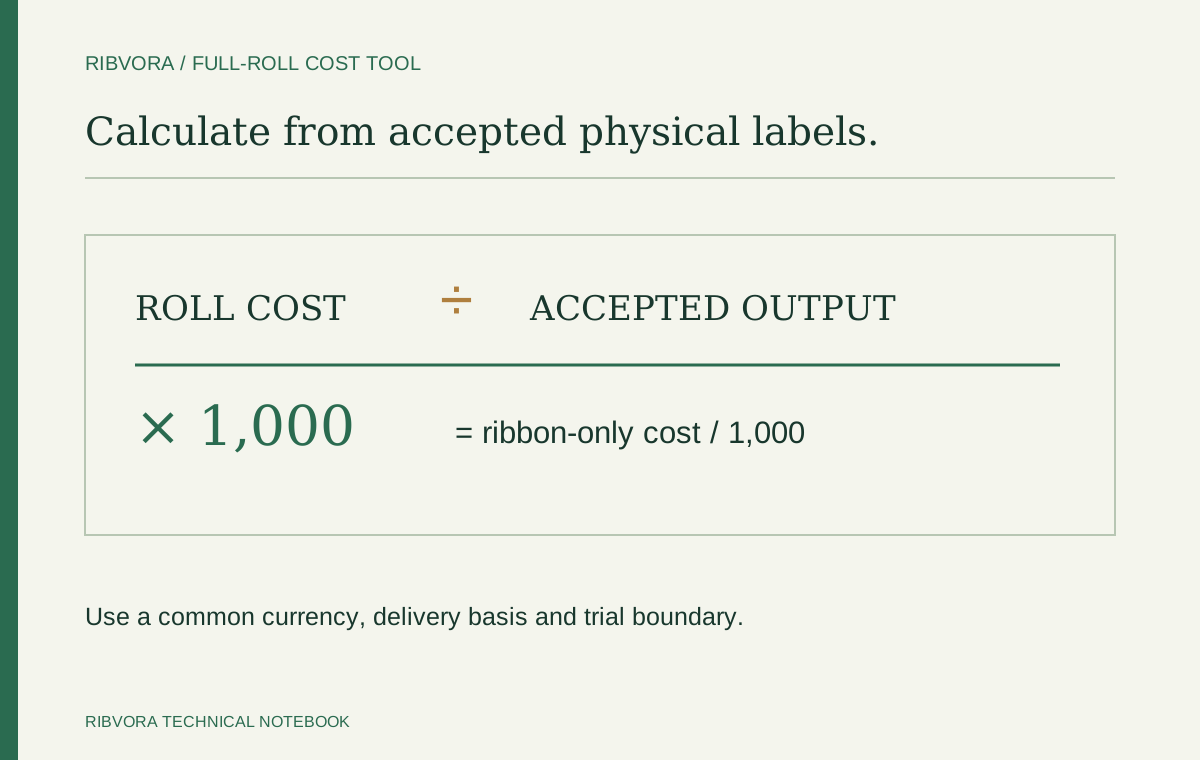
Ribbon cost per 1,000 accepted labels = (ribbon cost consumed in the measured job / accepted labels from the same job) × 1,000.
For a full-roll trial, use the cost of that roll and the accepted output attributable to it. For a multi-roll batch, use the ribbon cost consumed across the batch. If a trial uses only part of a roll, allocate the consumed portion on a documented basis; do not charge the whole roll to a short trial and compare that result with another supplier’s full-roll result.
Count each accepted physical label once. If a rejected print is replaced, the replacement may count when accepted, but the original reject does not. Use the same cost boundary for both candidates. For example, compare delivered ribbon cost with delivered ribbon cost, in one currency, rather than comparing one ex-works quote with another delivered price.
| Input | What to record |
|---|---|
| Ribbon cost | Cost of the consumed quantity; currency and delivery basis |
| Measurement boundary | Full roll, defined batch or measured part-roll consumption |
| Accepted labels | Physical labels meeting the agreed criteria |
| Rejected output | Quantity, reason and any reprints |
| Application approval | Label stock, artwork, print setup and required tests |
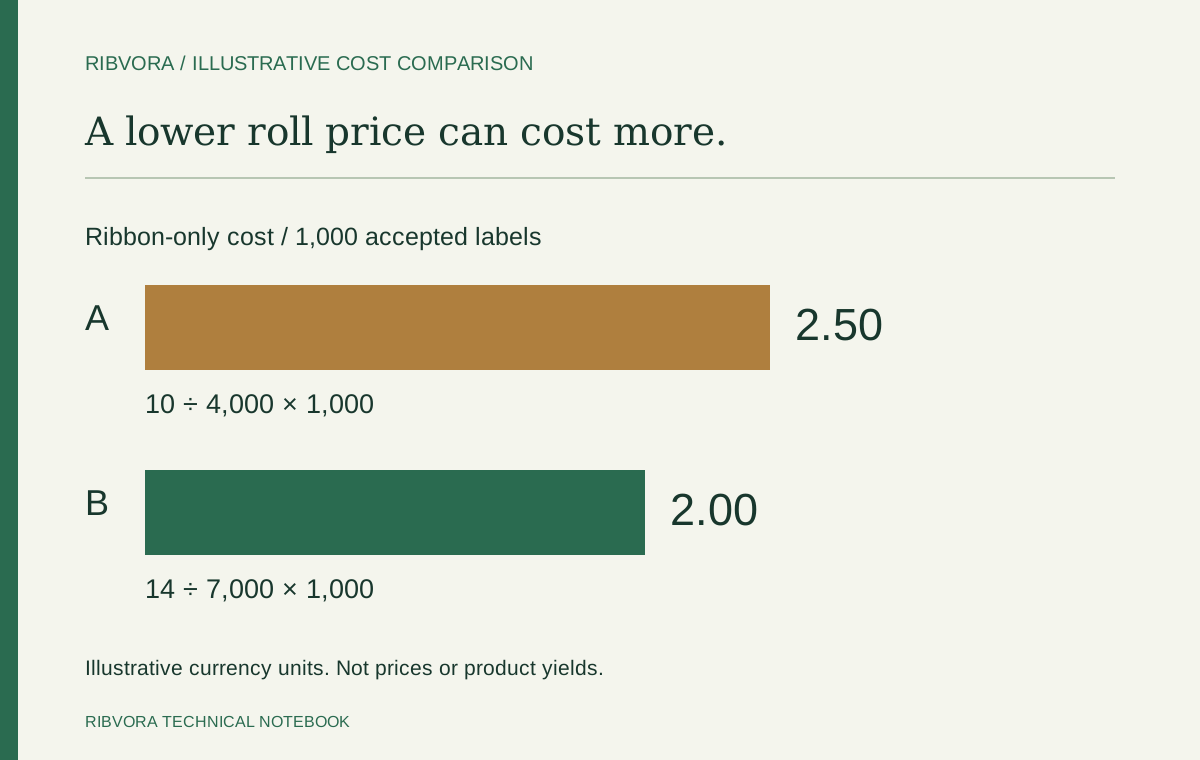
Worked example: a lower roll price can cost more
The following numbers are illustrative arithmetic only. They are not RIBVORA prices, measured yields, quotations or savings claims. Assume both candidates fit the printer, both meet the same application requirements, and each result is measured over a complete roll on the same cost basis.
Candidate A costs USD 12 per roll and produces 5,000 accepted labels: 12 / 5,000 × 1,000 = USD 2.40 per 1,000 accepted labels. Candidate B costs USD 17 and produces 8,000 accepted labels: 17 / 8,000 × 1,000 = USD 2.125, rounded to USD 2.13.
The roll-price ranking and output-cost ranking are different. This does not prove that a longer or more expensive roll is better. If B instead produces 7,000 accepted labels, its ribbon-only cost becomes about USD 2.43 per 1,000, slightly above A. Actual accepted output changes the decision.
| Illustrative input or result | Candidate A | Candidate B |
|---|---|---|
| Cost per complete roll | USD 12.00 | USD 17.00 |
| Accepted labels per complete roll | 5,000 | 8,000 |
| Ribbon-only cost per 1,000 accepted labels | USD 2.40 | USD 2.13 |
| Decision boundary | Same approved application | Same approved application |
Find the break-even output before running the trial
You can turn a quote into a useful trial target. To match A’s USD 2.40 per 1,000, a USD 17 roll needs at least 17 / 2.40 × 1,000 = 7,083.33 accepted labels. Because the output is counted in whole labels, B needs at least 7,084 accepted labels to meet or beat that ribbon-only cost.
Use the unrounded calculation when checking a close result. A small difference in a short trial may not be representative. Repeat a comparable job if the decision depends on a narrow margin, and record the range of results rather than selecting the best run.
This break-even figure says nothing about whether a ribbon passes the application tests. A candidate that fails a required durability or readability criterion is not an acceptable lower-cost substitute.
Keep an early estimate separate from observed output
Before samples arrive, quoted length can help with an estimate. Estimated print cycles = usable ribbon length / ribbon consumption per cycle, with both lengths in the same units. Multiply by the number of physical labels produced per cycle, then apply a clearly stated allowance for rejected output.
Use measured consumption or the relevant printer documentation for the actual job. Do not infer consumption only from the height of the black printed area, and do not assume that changing a roll length changes accepted output in exact proportion. State how setup consumption and unused remnants are handled in the estimate.
If those inputs are unknown, mark the estimate as incomplete. A supplier can quote a roll configuration without knowing your production yield. Replace assumptions with a recorded trial before treating the estimate as a purchasing result.
Run a comparison that purchasing and production can both use
Use the same printer, exact label stock and artwork for the comparison. Both candidates must satisfy the same acceptance requirements. Appropriate settings can differ between formulations, so record each approved setup rather than forcing identical settings and assuming that creates a fair trial.
For a full-roll comparison, log the beginning and end of the run, accepted count, rejected count and interruptions. Record the ribbon reference and batch identification where available. Keep rejected samples or clear photos so the reason for lost output can be reviewed.
Separate material-related problems from unrelated events such as an artwork correction. Include normal, repeatable setup loss consistently; identify exceptional events separately. This makes the decision easier to repeat on a reorder.
| Trial record | Entry to keep |
|---|---|
| Printer and job | Exact model, resolution and artwork revision |
| Label stock | Manufacturer, product reference and finish |
| Candidate ribbon | Formulation, dimensions, core, winding and batch where provided |
| Approved settings | Speed and energy; relevant operating mode |
| Measured output | Accepted labels, rejects and reasons |
| Ribbon consumed | Complete rolls or documented part-roll consumption |
| Application result | Required tests and agreed pass criteria |
| Commercial basis | Currency, delivered cost allocation and order quantity |
Add other costs without double counting them
Ribbon-only cost is one line of the decision. If you need total print-job cost, add the label stock consumed, attributable setup or rework labour, and other costs you actually measure. Use the same job boundary and divide by the same accepted-label count.
Do not add a second ribbon charge for rejects when their ribbon consumption is already included in the numerator. Likewise, avoid adding a guessed downtime penalty simply to make a preferred supplier look cheaper. Keep recorded costs, estimates and unmeasured risks in separate columns.
A converter or distributor should also keep its selling margin calculation separate. Customer delivery, packaging and account terms may matter to that business, but they do not change the ribbon-only production figure. Name the metric clearly so colleagues do not mistake a partial cost for a complete margin.
Turn the comparison into a useful ribbon enquiry
Send the printer model, exact label material, current roll specification and expected order quantity. Add your accepted output per roll if you have measured it. If yield is unknown, say so and request a specification and sample discussion before relying on a cost projection.
A useful request is: “We use this printer and label stock. Our current configuration produces this accepted count under this test requirement. Please review a candidate with the same fit and explain what we should measure in the sample trial.”
RIBVORA can review the information needed for a ribbon enquiry. Candidate suitability, sample availability, prices and commercial terms require a separate review. The example in this article is a calculation aid, not a quoted product offer.
Reconcile the counter with physical output
Find out whether the counter includes setup prints, rejects or repeated commands. Count accepted physical labels once within the measured boundary. Record discrepancies instead of treating every counter increment as usable output.
Keep estimated yield out of a measured-saving claim
A quotation comparison may use assumptions when production data is unavailable. Label them clearly and state what must be measured next. An illustrative calculation cannot establish a saving for an untested configuration.
Use the calculator after defining the boundary
The full-roll calculator accepts the cost of a complete roll and accepted output from that roll. For a part-roll trial, allocate the consumed ribbon first rather than mixing full-roll cost with partial output.
Review the commercial consequence before switching
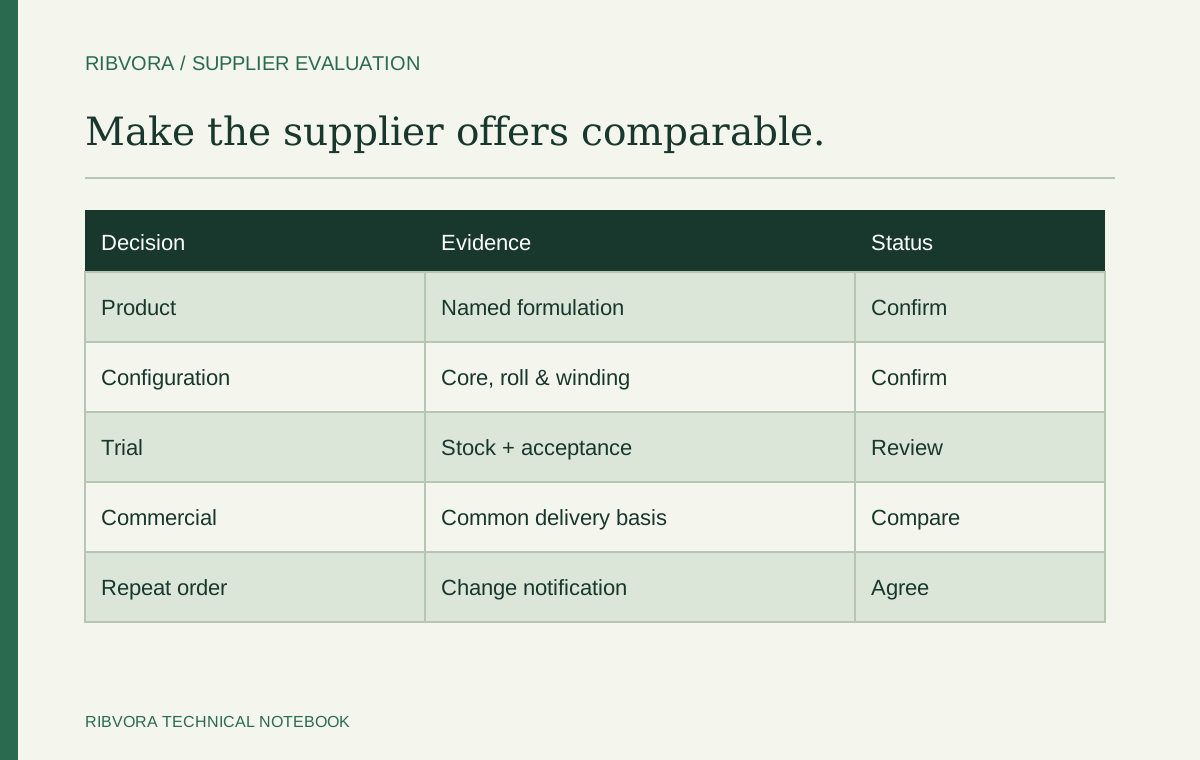
A lower ribbon-only result does not include every cost or supply risk. Keep packaging terms, required testing, stock planning and quality handling in the wider decision. Compare the result only within the approved application scope.
Common questions
Is price per metre enough to compare ribbons?
It helps normalize quoted roll lengths, but it does not show accepted output or prove application suitability. Compare mechanically suitable, approved candidates and measure the ribbon cost consumed per accepted label.
Can I use the printer’s label counter?
Use it only after confirming what that counter includes for the measured job. Reconcile it with accepted physical labels, rejects and reprints. A counter value alone does not establish an accepted-output count.
Does a longer roll always lower printing cost?
No. Confirm printer fit and application approval first. Compare delivered roll cost, actual consumption and accepted output. Do not assume a saving without the relevant measurements.
What if I only have supplier quotes and no production data?
Keep the comparison at quotation level and label yield assumptions explicitly. Confirm dimensions, formulation, delivery basis and quantities, then use a controlled sample trial to replace those assumptions.
Further reading & sources
These sources support general technical guidance. Product approval requires evidence for the exact formulation and application.