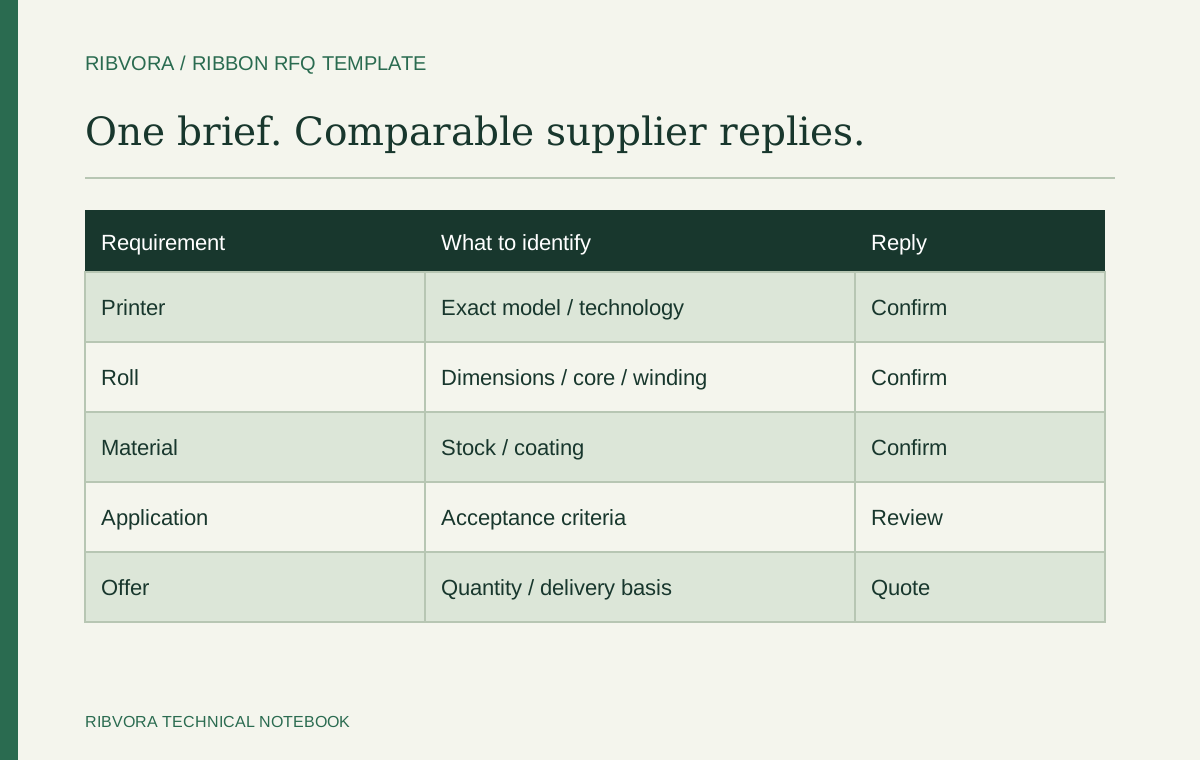
A useful ribbon RFQ identifies the exact printing setup and end use, separates confirmed details from unknowns, and requests a line-by-line offer with exclusions. Ask suppliers to identify any proposed substitution explicitly.
Start with evidence from the current setup
Collect the printer nameplate or model reference, the old ribbon label, both ends of the core and the label stock reference. Photograph the full liner width if the dimensions are uncertain.
A familiar printer brand does not confirm printhead technology, supported roll limits or winding. Check the exact model documentation. If a detail is unknown, leave it marked “to confirm” and attach the evidence you have.
| Field | Useful evidence | Avoid |
|---|---|---|
| Equipment | Exact model and print resolution | Printer brand alone |
| Roll configuration | Film width, length, outside diameter, core and winding | Matching width and length only |
| Label stock | Supplier reference, coating and full media width | “White synthetic” without a reference |
| Use conditions | Named process and agreed acceptance requirement | “Best quality” or “chemical proof” |
Make the quotation basis comparable
State the destination, quantities by configuration and desired delivery basis. Ask for the currency, price unit, sample terms, packaging, lead-time starting point and quotation validity. Do not assume a quoted roll includes freight, taxes or the same quantity break.
A delivery term must include its named place and any relevant exclusions. Clarify who handles import formalities before comparing a door-delivery proposal with an ex-works price. Use qualified trade advice where a contractual term needs interpretation.
Ask for a named candidate, not an unexplained equivalent
Request the formulation or supplier product reference and the proposed roll configuration in writing. If an alternative is offered, ask which details change and what needs to be retested.
Request the current datasheet and application-relevant documents. A generic brand catalogue or certificate logo does not establish that the offered formulation and printed label combination satisfy your requirement.
Agree how the sample will be evaluated
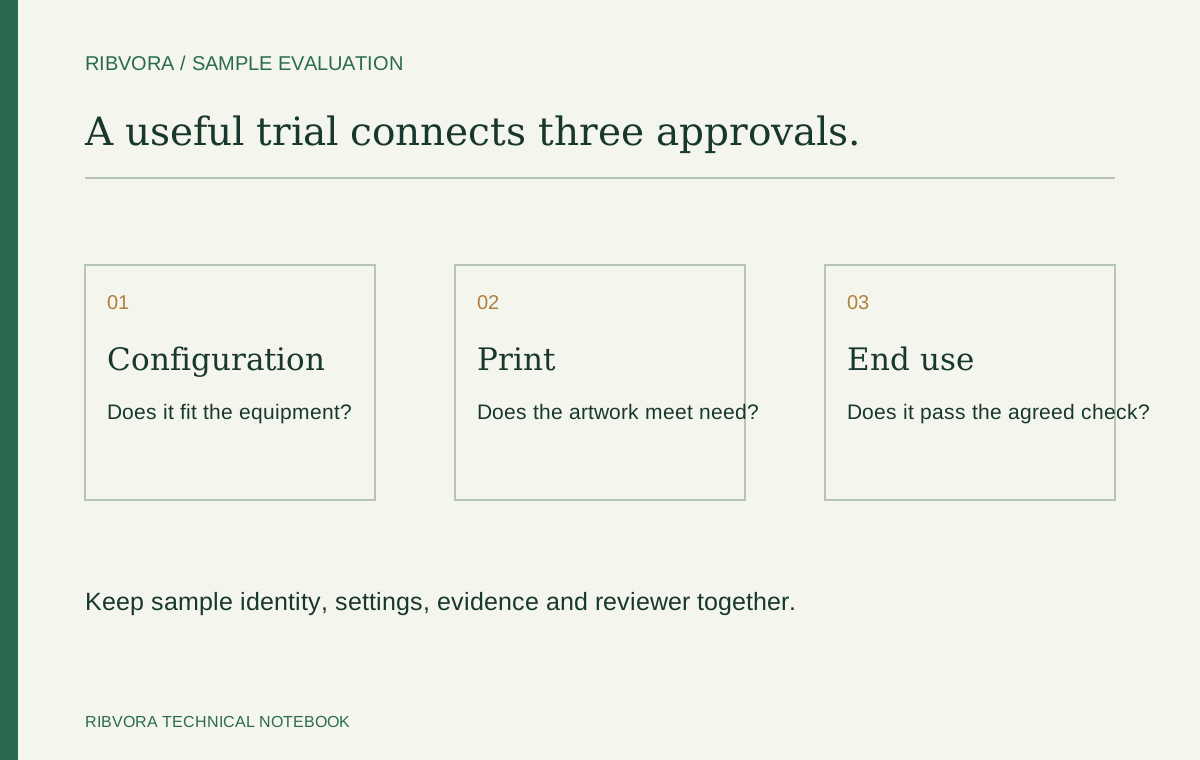
Use production label stock and the intended artwork. State the required print quality, exposure conditions and approval process before accepting a sample as the production reference.
For formal barcode or regulatory requirements, identify the actual required method and acceptance criteria with the responsible team. This template does not prescribe a grade or certification.
- Confirm sample identity and mechanical fit.
- Record the printer, stock and settings.
- Assess the smallest critical text and codes.
- Apply the defined end-use checks.
- Record the decision and any remaining conditions.
Review the reply before comparing the totals
Mark each line as confirmed, excluded, changed or unresolved. A supplier response that repeats only the dimensions has not answered the whole brief.
Keep the quoted reference with the sample record. If the supplier cannot identify a formulation or the test scope, resolve that gap before approving a bulk order.
Use the brief with RIBVORA
You can send the completed template through the specification enquiry form. If you are missing details, send the printer model and clear photos of the current roll first. Sample availability, candidate suitability and commercial terms are reviewed for the actual project.
State the outcome you want to preserve or improve
If the current roll works, say which printer and stock combination it serves. If it fails, name the failure and the exposure that causes it. This distinguishes a replacement enquiry from a new application trial.
List multiple configurations as separate items
Use one line per width, length, core and winding configuration with a quantity for each. Do not combine all demand into one total if the supplier needs different quantities to price the items.
Identify the attachments in the brief
Name the stock datasheet, old roll photo, artwork revision and test requirement. Share only authorized material. An unlabeled image of several rolls can create more questions than it resolves.
Ask which part of the offer is conditional
Have the supplier separate confirmed specifications from points awaiting a sample, stock check or document review. Keep quotation validity and lead-time assumptions visible instead of interpreting them as unconditional commitments.
Check the unit and usable-length basis
Confirm whether the price is per roll, carton or another unit and what quantity the carton contains. Ask how the stated configuration and any leader or trailer requirements are defined. Do not compare package totals as though they were roll prices.
Retain the answered RFQ as the order record
Save the final supplier response with the approved sample reference and order terms. Reopen a technical line when a substitution is proposed. This keeps a repeat order from losing details that were resolved during the first evaluation.
Common questions
Can I enquire without knowing the winding or core size?
Yes. Mark those fields as unknown and include photos of the existing roll and printer model. The missing configuration still needs confirmation before an order.
Should I send the same RFQ to every supplier?
Use the same confirmed technical and commercial requirement so differences in the replies are visible. Share only material you are authorized to disclose.
Does completing this template reserve stock or approve a sample?
No. It prepares an enquiry. Availability, quotation terms and sample approval remain separate decisions.
Further reading & sources
These sources support general technical guidance. Product approval requires evidence for the exact formulation and application.